Tech Giants Envision Future Beyond Smartphones
Tech Giants Envision Future Beyond Smartphones: The Next Digital Revolution

Tech Giants Envision a Future Beyond Smartphones
Introduction
For nearly two decades, smartphones have been at the center of modern life. They have transformed the way people communicate, work, shop, learn, and entertain themselves. From checking emails and browsing social media to navigating unfamiliar cities and managing finances, smartphones have become indispensable tools for billions of people worldwide. This article explores why tech giants are planning for a future beyond smartphones and examines the technologies that could define the next era of digital communication.
However, some of the world’s largest technology companies are already looking beyond smartphones and imagining what the next major technological revolution might be. As innovation accelerates, industry leaders are investing billions of dollars into emerging technologies that could eventually replace or significantly reduce our dependence on traditional mobile devices.
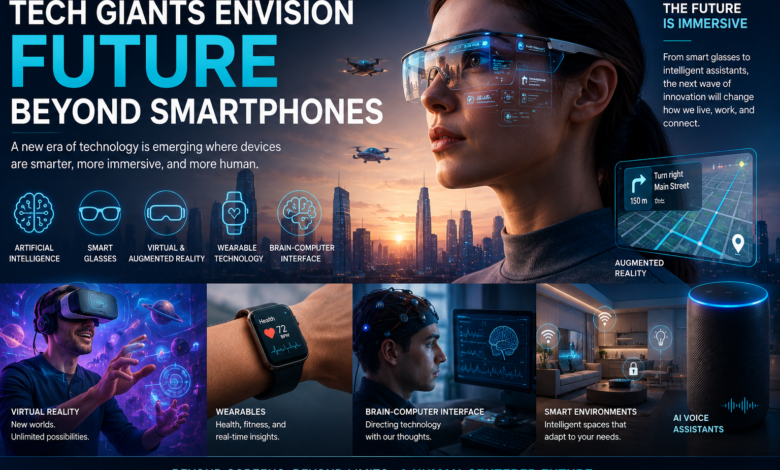
Artificial intelligence, augmented reality, virtual reality, wearable technology, smart glasses, brain-computer interfaces, and advanced voice assistants are among the innovations shaping this vision of the future. While smartphones are unlikely to disappear overnight, many experts believe that the next generation of technology will create more natural, immersive, and seamless ways for people to interact with the digital world.
Why Tech Companies Are Looking Beyond Smartphones
The smartphone market has reached a level of maturity that was difficult to imagine just a decade ago. Most modern smartphones offer excellent cameras, powerful processors, large displays, and advanced software features. While manufacturers continue introducing improvements, groundbreaking changes have become less frequent.
As a result, technology companies are searching for new opportunities to drive innovation and growth. The goal is not simply to build better devices but to create entirely new ways of connecting people with information and digital services.
Several factors are contributing to this shift:
Market Saturation
In many regions, smartphone ownership is already extremely high. Since most consumers already own capable devices, companies face increasing challenges in convincing users to upgrade frequently.
Advances in Artificial Intelligence
Artificial intelligence is rapidly changing how people interact with technology. Intelligent systems can understand voice commands, predict user needs, and provide personalized assistance, reducing the need for traditional app-based interactions.
Demand for More Natural Experiences
People increasingly want technology that blends into daily life rather than requiring constant attention. Future devices may work in the background, delivering information when needed without forcing users to stare at screens.
New Hardware Possibilities
Recent advances in sensors, displays, processors, and connectivity have created opportunities for entirely new categories of devices.
The Rise of Smart Glasses
One of the most promising alternatives to smartphones is smart glasses.
Unlike traditional mobile devices, smart glasses can display digital information directly within a user’s field of vision. This approach allows people to stay connected without constantly looking down at a screen.
Future smart glasses may provide:
- Navigation directions
- Real-time language translation
- Instant notifications
- Video communication
- Virtual workspaces
- Interactive entertainment
Many technology companies believe smart glasses could become the next major computing platform because they integrate digital information into everyday life more naturally than smartphones.
Instead of pulling a phone from a pocket, users could simply view information through lightweight eyewear.
Augmented Reality and Everyday Computing
Augmented reality (AR) is expected to play a central role in the post-smartphone future.
AR overlays digital elements onto the real world, allowing users to interact with information while remaining aware of their surroundings.
Imagine walking through a city while virtual directions appear on the road ahead. A traveler could see restaurant reviews floating beside buildings, while a technician could view repair instructions directly on machinery.
This technology has the potential to transform industries such as:
- Education
- Healthcare
- Retail
- Manufacturing
- Tourism
- Entertainment
As AR hardware becomes smaller and more powerful, experts expect it to become increasingly integrated into daily life.
Artificial Intelligence as the New Interface
For years, people have interacted with smartphones through touchscreens and apps. In the future, artificial intelligence may replace many of these traditional interfaces.
Advanced AI assistants could understand natural language, remember user preferences, and perform tasks automatically.
Instead of opening multiple applications, users might simply say:
“Book a flight for next Friday.”
“Schedule a meeting with my team.”
“Find a nearby restaurant that serves vegetarian food.”
The AI system would handle these tasks automatically.
This shift could significantly reduce reliance on screens and create more conversational interactions with technology.
Wearable Technology Expands Its Role
Wearable devices are already becoming common. Smartwatches, fitness trackers, and health-monitoring devices have introduced consumers to technology that remains connected throughout the day.
Future wearables may become far more sophisticated.
Potential capabilities include:
- Continuous health monitoring
- Stress detection
- Personalized wellness recommendations
- Advanced biometric authentication
- Real-time environmental awareness
As sensors improve, wearable devices may provide valuable insights while remaining nearly invisible to users.
The ultimate goal is to make technology more helpful without making it more intrusive.
Virtual Reality Beyond Gaming
Virtual reality (VR) is often associated with gaming, but its potential extends much further.
Future VR systems may revolutionize:
Remote Work
Employees could collaborate within immersive virtual offices regardless of their physical location.
Education
Students could explore historical events, scientific concepts, and distant locations through interactive simulations.
Training
Professionals could practice complex procedures in realistic virtual environments before applying skills in real-world situations.
Social Interaction
Virtual spaces may allow people to connect, communicate, and collaborate in entirely new ways.
As VR hardware becomes lighter, more affordable, and more comfortable, adoption is expected to increase significantly.
Brain-Computer Interfaces: A Long-Term Vision
Perhaps the most ambitious technology under development is the brain-computer interface (BCI).
BCIs aim to create direct communication between the human brain and digital systems.
Although still in the early stages, researchers believe these systems could eventually allow users to control devices through thought alone.
Potential applications include:
- Assisting individuals with disabilities
- Faster digital communication
- Advanced gaming experiences
- Improved accessibility tools
While widespread adoption remains years away, brain-computer interfaces represent one of the most fascinating possibilities for the future of human-computer interaction.
Challenges Facing the Post-Smartphone Era
Despite the excitement surrounding emerging technologies, several challenges must be addressed before smartphones can be replaced.
Privacy Concerns
Devices that constantly collect information raise important questions about data security and personal privacy.
Cost
New technologies often launch with high price tags, limiting accessibility for many consumers.
Battery Life
Smaller, more powerful devices require efficient energy solutions to support all-day usage.
User Adoption
Consumers must see clear benefits before abandoning familiar technologies.
Regulation
Governments and regulatory organizations may need to establish new guidelines for emerging technologies.
Overcoming these challenges will be essential for widespread adoption.
Will Smartphones Disappear Completely?
Although technology companies are investing heavily in alternatives, smartphones are unlikely to vanish anytime soon.
Instead, experts expect a gradual transition in which smartphones work alongside emerging devices.
For many years, users may rely on a combination of:
- Smartphones
- Smart glasses
- Wearable devices
- AI assistants
- Augmented reality systems
Eventually, as newer technologies become more capable and convenient, smartphones may play a smaller role in daily life.
The Future of Human-Technology Interaction
The future envisioned by technology leaders extends beyond creating new gadgets. The broader goal is to make technology more intuitive, accessible, and seamlessly integrated into everyday activities.
Instead of constantly interacting with screens, people may communicate naturally through voice, gestures, visual interfaces, and intelligent assistants.
Technology could become less visible while becoming more powerful.
This shift would represent one of the most significant transformations since the introduction of the smartphone itself.
Conclusion
The smartphone revolution changed the world, but technology companies are already preparing for what comes next. Through advancements in artificial intelligence, smart glasses, augmented reality, wearable technology, virtual reality, and brain-computer interfaces, the industry is building a future where digital experiences become more immersive and effortless.
While smartphones will remain important for years to come, the next generation of devices aims to create deeper connections between people and technology. As innovation continues to accelerate, the coming decades may bring changes that redefine how humans communicate, work, learn, and interact with the digital world.
The future beyond smartphones is no longer science fiction—it is a vision actively being developed by today’s technology giants.