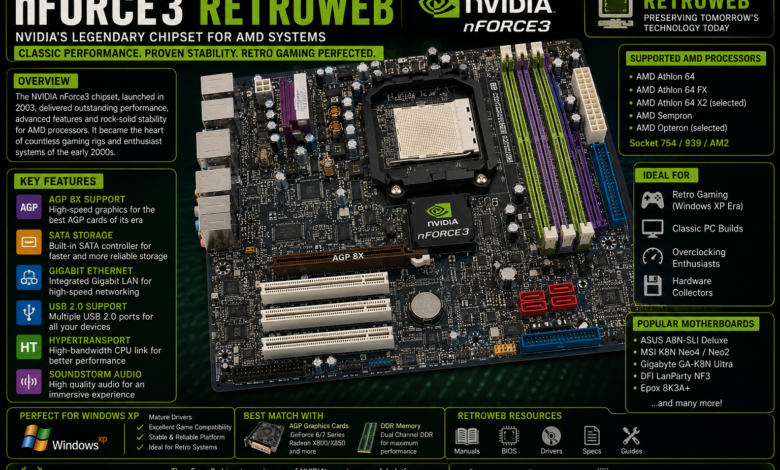
The early 2000s were a golden era for PC enthusiasts, with rapid advancements in processors, graphics cards, and motherboard technology. During this period, NVIDIA expanded beyond graphics hardware and introduced a series of motherboard chipsets that quickly became popular among gamers and power users. One of the most successful was the nForce3 chipset, a platform remembered for its excellent performance, stability, and support for AMD processors.
Today, many retro computing enthusiasts search for nForce3 RetroWeb to find documentation, BIOS updates, chipset drivers, and compatibility information for restoring classic desktop PCs. Whether you’re building a Windows XP gaming system or preserving vintage computer hardware, the nForce3 chipset remains an important part of PC history.
This guide explores the history of the NVIDIA nForce3 chipset, its features, supported hardware, gaming performance, and why it continues to attract retro PC builders.
What Is the NVIDIA nForce3 Chipset?
The NVIDIA nForce3 is a motherboard chipset introduced in 2003 for AMD-based desktop systems. It was designed to provide high performance, advanced storage options, networking capabilities, and reliable platform stability.
Unlike modern chipsets that focus heavily on PCI Express technology, the nForce3 belongs to the AGP era, making it especially attractive for enthusiasts restoring classic gaming computers.
It became widely used on motherboards from manufacturers including:
- ASUS
- MSI
- Gigabyte
- DFI
- ASRock
- Epox
Its combination of speed and flexibility made it one of NVIDIA’s most respected chipset families.
Key Features of nForce3
The chipset introduced several advanced features for its time.
AGP 8X Graphics
The nForce3 supports AGP 8X graphics cards, allowing users to install powerful GPUs from NVIDIA and ATI that were popular before PCI Express became the industry standard.
SATA Storage Support
Serial ATA support improved storage performance while simplifying cable management compared to older IDE drives.
Integrated Gigabit Ethernet
Many nForce3 motherboards included built-in Gigabit networking for faster local network performance.
USB 2.0 Connectivity
Support for USB 2.0 enabled higher-speed transfers for flash drives, printers, scanners, and external storage devices.
HyperTransport Technology
The chipset worked with AMD’s HyperTransport architecture, providing faster communication between the processor and motherboard components.
Supported AMD Processors
The nForce3 chipset supported several well-known AMD processor families, depending on the motherboard model.
Common supported CPUs include:
- AMD Athlon 64
- Athlon 64 FX
- Athlon 64 X2 (selected models)
- Sempron
- Opteron (on compatible boards)
This flexibility made upgrading easier without replacing the entire system.
Performance for Windows XP Gaming
One of the main reasons enthusiasts still use nForce3 systems is their excellent Windows XP compatibility.
Popular games that perform well on properly configured systems include:
- Half-Life 2
- Doom 3
- Far Cry
- Battlefield 2
- Counter-Strike: Source
- Need for Speed: Most Wanted
- Warcraft III
Paired with graphics cards such as the GeForce 6800 GT or Radeon X850 XT, nForce3 systems delivered impressive gaming performance during the mid-2000s.
Why RetroWeb Is Valuable
Retro computing communities help preserve knowledge that is no longer available from many hardware manufacturers.
People searching for nForce3 RetroWeb often look for:
- Motherboard manuals
- Legacy chipset drivers
- BIOS updates
- CPU compatibility lists
- Hardware specifications
- Installation guides
- Restoration tips
These resources are invaluable when repairing or rebuilding older computers.
Building a Retro Gaming PC
A typical nForce3-based gaming system may include:
Processor
AMD Athlon 64 or Athlon 64 X2.
Motherboard
An ASUS, MSI, Gigabyte, DFI, or ASRock nForce3 motherboard.
Memory
2 GB to 4 GB of DDR memory.
Graphics Card
An AGP graphics card such as the NVIDIA GeForce 6800 Ultra or ATI Radeon X800 series.
Storage
A SATA SSD with a compatible adapter can improve responsiveness while maintaining compatibility.
Operating System
Windows XP Professional remains the preferred operating system for most retro gaming enthusiasts.
Advantages of the nForce3 Platform
The chipset earned its reputation for several reasons.
Excellent Stability
Reliable performance made it popular among gamers and professionals.
Strong Gaming Support
It handled many DirectX 9 titles with ease.
Broad Hardware Compatibility
Support for multiple AMD processors and AGP graphics cards increased flexibility.
Upgrade Potential
Many systems could be upgraded without replacing the motherboard.
Active Retro Community
Online forums and RetroWeb archives continue supporting legacy hardware owners.
Challenges of Using Legacy Hardware
Older systems require additional maintenance and planning.
Common challenges include:
- Aging capacitors
- Limited DDR memory availability
- Driver installation
- BIOS updates
- Finding working AGP graphics cards
- Replacing CMOS batteries
Fortunately, many of these issues can be resolved using preserved documentation and community resources.
Tips for Restoring an nForce3 System
To improve long-term reliability:
- Replace the CMOS battery.
- Clean dust from cooling components.
- Apply fresh thermal paste to the CPU.
- Install the latest compatible BIOS.
- Archive chipset drivers and manuals.
- Test memory modules before installing Windows.
These simple steps help maintain classic hardware for years to come.
Why Enthusiasts Still Search for nForce3 RetroWeb
Interest in the nForce3 RetroWeb keyword continues because collectors and hobbyists want reliable information about restoring and upgrading vintage computers.
Retro computing remains popular for several reasons:
- Classic PC gaming
- Hardware preservation
- Windows XP compatibility
- Educational projects
- Vintage benchmarking
- Collecting rare components
The nForce3 chipset continues to represent one of the most successful motherboard platforms of the early AMD gaming era.
Conclusion
The NVIDIA nForce3 chipset played a major role in the evolution of desktop computing by providing fast, reliable, and feature-rich motherboard technology for AMD processors. Its support for AGP graphics, HyperTransport, SATA storage, and Windows XP made it a favorite among gamers and enthusiasts.
Today, searches for nForce3 RetroWeb reflect the continued popularity of retro computing. With the help of RetroWeb resources, collectors and hobbyists can preserve these classic systems, restore vintage hardware, and experience the golden age of PC gaming once again.