Artificial intelligence is entering a new era. Traditional AI systems have primarily focused on analyzing data, generating content, and automating repetitive tasks. However, the emergence of Agentic AI is transforming how organizations approach decision-making, cybersecurity, identity verification, and customer interactions. Unlike conventional AI systems that respond to prompts, Agentic AI can autonomously plan, reason, take actions, and achieve goals with minimal human intervention.
At the same time, identity security has become a critical challenge for businesses worldwide. As digital interactions increase, organizations face growing threats from fraud, account takeovers, synthetic identities, and cyberattacks. Innovative companies such as Pindrop and Anonybit are helping address these challenges through advanced identity verification, voice authentication, biometric security, and privacy-first technologies.
The convergence of Agentic AI, biometric identity systems, and cybersecurity solutions represents one of the most significant technological shifts of the decade. This article explores the role of Agentic AI, the innovations associated with Pindrop and Anonybit, and how these technologies are reshaping digital trust and enterprise security.
Understanding Agentic AI
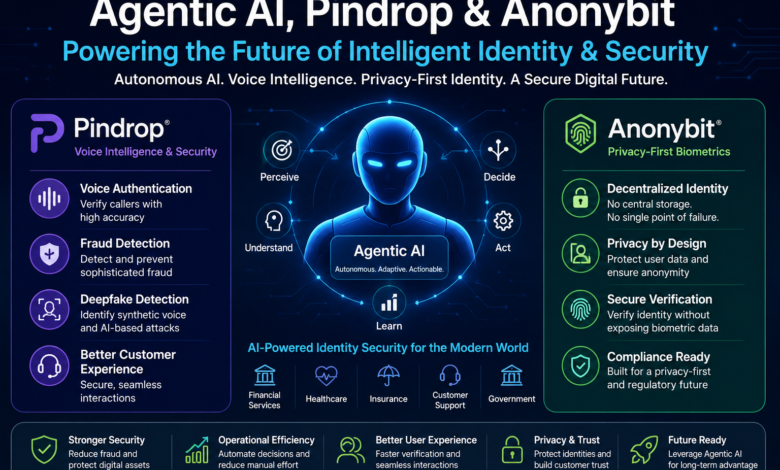
Agentic AI refers to artificial intelligence systems capable of acting independently to achieve specific objectives. Unlike traditional AI models that require continuous user guidance, agentic systems can:
- Analyze situations
- Create action plans
- Make decisions
- Execute tasks
- Learn from outcomes
- Adapt strategies over time
These systems function more like intelligent digital agents than simple software tools.
Key Characteristics of Agentic AI
Autonomy
Agentic AI can operate with minimal supervision while pursuing predefined goals.
Reasoning
Advanced AI agents evaluate multiple options before selecting the most effective course of action.
Adaptability
The system continuously learns from interactions and environmental changes.
Multi-Step Execution
Instead of handling isolated requests, agentic AI manages entire workflows from start to finish.
Collaboration
Multiple AI agents can work together to solve complex business challenges.
Why Agentic AI Matters
Organizations are increasingly adopting AI to improve productivity and operational efficiency. Agentic AI takes automation to the next level by reducing the need for constant human oversight.
Benefits include:
- Faster decision-making
- Improved operational efficiency
- Enhanced customer experiences
- Reduced operational costs
- Scalable automation
- Better risk management
As businesses seek greater agility, Agentic AI is becoming a strategic priority across industries.
The Growing Importance of Digital Identity
As organizations digitize services, verifying user identities has become more challenging.
Businesses must address:
- Identity theft
- Account takeover attacks
- Deepfake fraud
- Voice spoofing
- Credential theft
- Synthetic identities
Traditional authentication methods such as passwords are no longer sufficient to protect users and organizations.
This has created demand for advanced identity verification solutions powered by AI and biometrics.
Pindrop and Voice Security Innovation
Pindrop has become widely recognized for its work in voice authentication, fraud detection, and call center security.
Voice interactions remain a critical channel for banks, healthcare providers, insurance companies, and customer support organizations. Unfortunately, cybercriminals increasingly target voice channels using sophisticated techniques.
Voice Authentication
Voice biometrics use unique characteristics of an individual’s voice to verify identity.
Benefits include:
- Faster customer verification
- Reduced fraud
- Improved user experience
- Enhanced security
Fraud Detection
AI-driven voice analysis can identify suspicious activity by examining:
- Call patterns
- Behavioral signals
- Acoustic characteristics
- Device information
This enables organizations to detect fraud before significant damage occurs.
Deepfake Detection
The rise of generative AI has increased concerns regarding synthetic voice attacks.
Advanced AI systems can analyze voice recordings to identify signs of manipulation and detect potential deepfake threats.
Customer Experience Enhancement
By reducing lengthy authentication processes, voice-based identity verification creates smoother customer interactions while maintaining strong security standards.
Anonybit and Privacy-First Biometrics
While biometric authentication offers significant advantages, privacy concerns remain a major challenge.
Anonybit represents a growing movement toward privacy-preserving identity systems that protect user data while enabling secure authentication.
Decentralized Biometrics
Traditional biometric systems often store sensitive information in centralized databases.
This creates risks such as:
- Data breaches
- Unauthorized access
- Identity theft
Decentralized approaches distribute biometric information securely, reducing single points of failure.
Privacy Protection
Privacy-first biometric systems are designed to:
- Minimize data exposure
- Protect personal information
- Support regulatory compliance
- Reduce cybersecurity risks
Secure Identity Verification
Organizations can verify identities without exposing underlying biometric data.
This approach enhances trust while maintaining strong security.
Compliance Readiness
As privacy regulations continue evolving globally, organizations increasingly seek solutions that align with modern compliance requirements.
Agentic AI and Identity Security
The combination of Agentic AI with biometric identity technologies creates powerful new opportunities.
AI agents can assist in:
Real-Time Risk Assessment
Agentic systems continuously evaluate user behavior and authentication signals.
Potential threats can be identified instantly.
Automated Fraud Prevention
AI agents can:
- Monitor suspicious activities
- Trigger security actions
- Escalate alerts
- Block unauthorized access
without waiting for manual intervention.
Intelligent Identity Management
Organizations can automate identity lifecycle processes including:
- User onboarding
- Verification
- Access management
- Compliance monitoring
Adaptive Authentication
Agentic AI can dynamically adjust security requirements based on risk levels and user behavior.
Industry Applications
Financial Services
Banks use AI-powered identity verification to reduce fraud and improve customer onboarding.
Applications include:
- Voice authentication
- Fraud monitoring
- Identity verification
- Secure transactions
Healthcare
Healthcare providers must protect sensitive patient information while ensuring convenient access.
AI-enabled identity solutions support:
- Patient authentication
- Secure medical records access
- Compliance management
Insurance
Insurance companies use intelligent verification systems to combat fraud and accelerate claims processing.
Government Services
Public sector organizations increasingly explore AI-driven identity systems for citizen services and digital governance.
Customer Support
Call centers benefit from faster verification, reduced fraud, and improved customer experiences through AI-powered voice security.
Challenges and Considerations
Despite the potential benefits, organizations must address several challenges.
Ethical AI Usage
Agentic AI systems should operate transparently and responsibly.
Organizations must establish clear governance frameworks.
Privacy Concerns
Identity verification solutions must balance security with user privacy.
Security Risks
AI systems themselves can become targets for cyberattacks.
Strong safeguards are essential.
Regulatory Compliance
Businesses must remain compliant with evolving privacy and AI regulations.
Human Oversight
Critical decisions should continue to involve appropriate human supervision.
Future Trends
The future of Agentic AI, voice authentication, and decentralized identity systems is expected to include:
AI-Powered Security Agents
Autonomous security agents will detect and respond to threats in real time.
Advanced Biometric Authentication
Biometric verification will become more accurate and secure.
Deepfake Defense Systems
Organizations will increasingly deploy AI solutions capable of identifying synthetic media attacks.
Decentralized Identity Networks
Privacy-preserving identity systems will gain broader adoption.
Continuous Authentication
Instead of one-time verification, users will be authenticated continuously throughout digital interactions.
The Strategic Value for Businesses
Organizations that invest in intelligent identity solutions can gain significant advantages.
Benefits include:
- Stronger cybersecurity
- Improved customer trust
- Reduced fraud losses
- Better compliance readiness
- Enhanced operational efficiency
- Superior user experiences
As digital ecosystems become more complex, identity security will remain a critical component of business resilience.
Conclusion
Agentic AI is redefining what artificial intelligence can achieve by enabling autonomous decision-making, adaptive learning, and intelligent task execution. At the same time, innovators such as Pindrop and Anonybit highlight the growing importance of secure, privacy-focused identity verification in a digital-first world.
Together, these technologies are helping organizations address some of today’s most pressing challenges, including fraud prevention, biometric security, customer authentication, and cyber resilience. As AI capabilities continue advancing, the integration of Agentic AI with voice authentication and decentralized identity systems will play a central role in building secure, trusted, and intelligent digital experiences for the future.