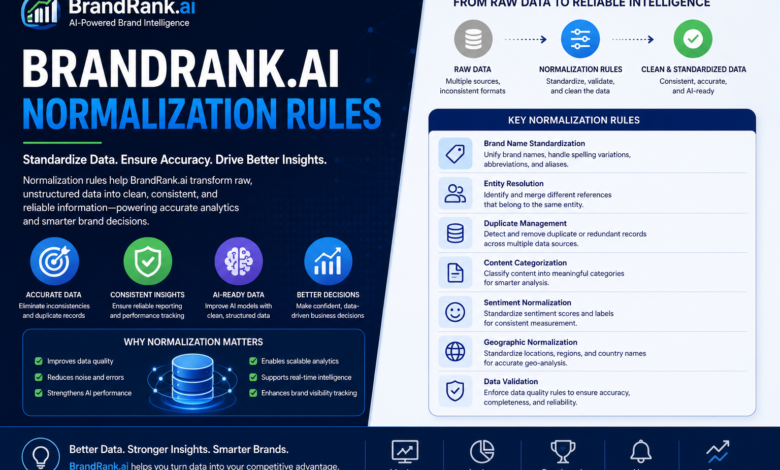
In today’s digital-first economy, brands generate enormous amounts of data across websites, social media platforms, online marketplaces, customer reviews, news publications, and search engines. While this data provides valuable insights, it often arrives in inconsistent formats, making analysis difficult. This is where BrandRank.ai Normalization Rules play a crucial role.
Normalization rules help organize, standardize, and structure data so that businesses can accurately measure brand performance, customer sentiment, market visibility, and competitive positioning. Without proper normalization, data from multiple sources may produce inaccurate results, duplicate records, and misleading analytics.
As artificial intelligence becomes increasingly important for brand monitoring and digital intelligence, normalization serves as the foundation for reliable decision-making. Businesses that implement strong normalization practices can improve data quality, enhance reporting accuracy, and gain deeper insights into customer behavior and market trends.
This article explores the concept of BrandRank.ai normalization rules, their importance, benefits, implementation strategies, challenges, and future applications in AI-driven brand intelligence.
What Are Data Normalization Rules?
Data normalization refers to the process of transforming information into a standardized format so that it can be analyzed consistently.
When organizations collect information from multiple channels, data often appears in different forms.
For example:
- Brand names may have different spellings
- Product categories may vary between platforms
- Customer information may be duplicated
- Social media mentions may contain abbreviations
- Regional language differences may create inconsistencies
Normalization rules establish guidelines for handling these variations and ensuring consistency throughout the dataset.
Why Normalization Matters for Brand Intelligence
Brand intelligence platforms rely heavily on accurate and organized information.
Without normalization, businesses may face:
- Duplicate records
- Inconsistent reporting
- Poor data quality
- Incorrect performance metrics
- Inaccurate sentiment analysis
- Misleading competitive insights
Normalization improves reliability and creates a stronger foundation for AI-powered analytics.
Improved Accuracy
Standardized data reduces errors and ensures consistent reporting.
Better Decision-Making
Executives can make more informed decisions when analytics are based on clean and accurate information.
Enhanced Automation
AI systems perform better when data follows consistent structures and formats.
Stronger Insights
Normalization helps reveal patterns that might otherwise remain hidden within fragmented datasets.
Understanding BrandRank.ai Normalization Rules
BrandRank.ai normalization rules can be viewed as structured guidelines that help organize brand-related information for analysis and ranking purposes.
These rules often focus on:
- Brand name standardization
- Entity matching
- Duplicate removal
- Content categorization
- Data validation
- Sentiment consistency
- Source alignment
The goal is to ensure that all collected information accurately reflects the intended brand or entity.
Brand Name Standardization
One of the most common normalization challenges involves brand names.
A single brand may appear in various formats across digital platforms.
Examples include:
- BrandRank AI
- BrandRank.ai
- Brand Rank AI
- BrandRankAI
Without normalization, systems may incorrectly treat these references as separate entities.
Standardization rules help consolidate these variations into a single recognized brand identity.
Benefits
- Improved reporting accuracy
- Better visibility tracking
- More reliable performance metrics
Entity Resolution and Matching
Entity resolution is the process of identifying when different records refer to the same organization, product, or brand.
For example, a company may be mentioned in:
- News articles
- Social media posts
- Customer reviews
- Business directories
AI-powered normalization systems can identify relationships between these references and merge them appropriately.
This prevents duplicate entries and strengthens data integrity.
Duplicate Data Management
Duplicate information is a major challenge in large-scale data collection.
Common sources of duplication include:
- Multiple data providers
- Reposted content
- Cross-platform mentions
- Repeated customer records
Normalization rules help identify duplicates and maintain a single, accurate version of each record.
Advantages
- Reduced storage requirements
- Improved reporting
- Higher data quality
Content Categorization Rules
Brand intelligence platforms often collect information from numerous sources.
Normalization rules help classify content into meaningful categories such as:
- Customer feedback
- Product reviews
- News coverage
- Social media discussions
- Competitor mentions
- Industry insights
Proper categorization improves analysis and reporting capabilities.
Sentiment Normalization
Sentiment analysis plays an important role in understanding public perception.
However, sentiment scoring can vary depending on language, context, and source.
Normalization rules help create consistency by:
- Standardizing sentiment scales
- Aligning scoring methodologies
- Reducing classification errors
This improves the accuracy of customer opinion tracking.
Geographic Data Normalization
Global brands often operate across multiple countries and regions.
Location data may appear in different formats.
Examples include:
- New York
- NYC
- New York City
Normalization rules standardize geographic references to improve regional reporting and analysis.
Benefits
- Better market segmentation
- Improved location-based insights
- Enhanced regional performance tracking
Keyword and Topic Standardization
Brands are frequently associated with multiple keywords, products, and industry terms.
Normalization helps group related topics together.
For example:
- Artificial Intelligence
- AI
- Machine Learning Solutions
These terms may be linked through predefined normalization rules to provide more accurate trend analysis.
Data Validation Rules
Data validation ensures that incoming information meets predefined quality standards.
Validation checks may include:
- Required fields
- Formatting standards
- Character limits
- Source verification
- Date consistency
High-quality validation processes reduce errors and improve overall reliability.
AI and Automation in Normalization
Modern normalization systems increasingly rely on artificial intelligence.
AI-powered normalization can:
- Detect patterns automatically
- Identify duplicate entities
- Standardize language variations
- Improve classification accuracy
- Continuously learn from new data
This reduces manual effort while improving scalability.
Machine Learning Applications
Machine learning models help normalization systems adapt to changing data environments and emerging trends.
As datasets grow, AI becomes increasingly valuable for maintaining accuracy and efficiency.
Benefits of Effective Normalization Rules
Improved Analytics
Accurate data leads to more reliable insights and better reporting.
Enhanced Brand Monitoring
Organizations gain a clearer understanding of brand visibility and reputation.
Better Competitive Intelligence
Normalized datasets enable fair and accurate comparisons between competitors.
Increased Operational Efficiency
Automation reduces manual data-cleaning requirements.
Stronger AI Performance
AI systems perform more effectively when trained on standardized information.
Challenges of Data Normalization
Despite its advantages, normalization presents several challenges.
Data Volume
Large datasets require sophisticated processing methods.
Language Variations
Global brands encounter multiple languages and regional terminology.
Constant Data Changes
Digital content evolves rapidly, requiring ongoing updates to normalization rules.
Ambiguous References
Some mentions may be difficult to classify accurately without contextual understanding.
Organizations must continuously refine normalization strategies to maintain effectiveness.
Best Practices for Implementing Normalization Rules
Establish Clear Standards
Define consistent rules for naming conventions, classifications, and formatting.
Automate Where Possible
AI-powered solutions improve scalability and reduce manual effort.
Monitor Data Quality
Regular audits help identify issues and maintain accuracy.
Update Rules Frequently
Normalization frameworks should evolve alongside changing business requirements.
Validate Results
Organizations should verify outputs to ensure that normalization processes are functioning correctly.
Future Trends in Brand Intelligence Normalization
Several trends are expected to shape the future of normalization systems.
AI-Driven Entity Recognition
Advanced models will improve the identification of brands, products, and organizations.
Real-Time Normalization
Businesses will increasingly process and standardize data instantly.
Multilingual Intelligence
Normalization systems will better support global datasets and language diversity.
Predictive Data Quality Management
AI will proactively identify potential inconsistencies before they impact reporting.
Integrated Brand Ecosystems
Future platforms will unify normalization, analytics, monitoring, and reporting within a single intelligent framework.
Why Normalization Is Critical for Brand Success
In a competitive digital marketplace, businesses rely on accurate data to guide strategy and measure performance.
Normalization rules ensure that:
- Analytics remain reliable
- Brand monitoring stays accurate
- Competitive insights are trustworthy
- AI systems operate effectively
- Decision-making is data-driven
Without standardized information, even the most advanced analytics platforms may produce misleading results.
Conclusion
BrandRank.ai Normalization Rules represent a fundamental component of modern brand intelligence and AI-powered analytics. By standardizing data, resolving duplicates, validating information, and improving consistency, normalization creates the foundation for accurate insights and informed decision-making.
As organizations continue to collect data from an expanding range of digital sources, the importance of effective normalization will only increase. Businesses that invest in strong normalization practices can improve reporting accuracy, strengthen AI performance, enhance brand monitoring, and gain a competitive advantage in today’s data-driven landscape.
In the future, AI-powered normalization systems will become even more intelligent, enabling organizations to manage increasingly complex datasets while maintaining the accuracy and consistency needed for successful brand intelligence strategies.